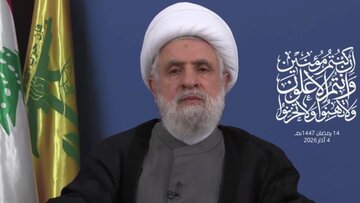

AhlulBayt News Agency (ABNA): The scientific meeting on "The Jurisprudence of Revenge" was held by the Political Jurisprudence Group of the Jurisprudential Center of the Imams (a.s.) and with a speech by Ayatollah Mohammad Javad Fazel Lankarani and the presence of a group of seminary and university professors, researchers, seminary students, and university students at this center.
Ayatollah Mohammad Javad Fazel Lankarani at this meeting explained the lexical, Quranic, and jurisprudential foundations of revenge and how it transforms from a "personal right" to a "public duty."
At the beginning of the discussion, to clarify the conceptual boundaries of the subject, he distinguished the four key terms "revenge," "retaliation," "reciprocity," and "blood-seeking" from one another and said, "Citing sources such as Misbah al-Munir and Mufradat of Raghib al-Isfahani, the word 'naqama' in the trilateral root denotes aversion, fault-finding, and reproach, but when it goes to the ifta'al form and becomes 'intiqam' (revenge), it takes on the meaning of aversion and disgust accompanied by punishment and practical reaction, which is more general than worldly and otherworldly punishment."
The member of the Society of Teachers of the Qom Seminary stated, "This concept has a fundamental difference with 'qisas' (retaliation); because qisas relates merely to a crime against life or limb and requires exact equivalence with the crime, while revenge has a broader scope and is not limited to physical crime and does not have the condition of identity in the type and details of the act; although observing justice and avoiding transgression is necessary in it."
Fazel Lankarani stressed, "Reciprocity" in the position of response and deterrence means observing proportion and not committing double oppression, not repeating the exact quality of the aggressor's act. Also, "blood-seeking" in the context of collective oppressions, especially regarding religious leaders, takes on a social and public nature.
The head of the Jurisprudential Center of the Imams (a.s.) further, citing numerous verses of the Holy Quran, including "Indeed, God is Exalted in Might and Owner of Retribution" (Ibrahim: 47), "Then God will take retribution from him" (Ma'idah: 95), "Indeed, We will take retribution from the criminals" (Sajdah: 22), "So We took retribution from those who committed crimes" (Rum: 47), and "So when they angered Us, We took retribution from them" (Zukhruf: 55), noted, "Causes such as disbelief, persistence in sin, crime, and oppression are the subject and origin of divine retribution."
The prominent professor of advanced jurisprudence and principles at the Qom seminary considered the claim of the exclusivity of revenge to the essence of God to lack a jurisprudential and interpretive basis and, to prove the legitimacy of human revenge, cited verses such as "And the recompense of an evil deed is an evil deed the like thereof" (Shura: 40), "And whoever avenges himself after being wronged, for those there is no cause against them" (Shura: 41), "So whoever has assaulted you, then assault him in the same way that he has assaulted you" (Baqarah: 194), and "And whoever is killed unjustly, We have given his heir authority" (Isra: 33).
Also, referring to the narrations and themes of the Ziyarat of Ashura, he raised this ijtihad possibility that, given the paternal position of the Noble Prophet (p.b.u.h) and the Imam (a.s.) for the ummah, the title of "avenger of blood" and the right of blood-seeking against great crimes can also extend to the entire ummah and Shiites.
Mohammad Javad Fazel Lankarani, referring to the fact that the main and technical axis of the discussion at this meeting is explaining the boundary between "right" and "duty," noted, "The verses that emphasize the preference of patience and forgiveness, such as 'So whoever forgives and makes reconciliation' (Shura: 40) and 'And whoever is patient and forgives' (Shura: 43), relate to purely personal rights in which forgiveness has priority; but when a public oppression occurs against society, religion, and the Islamic system or in the form of the martyrdom of the leader, commanders, and the children of Minab, a right is formed for the general public that, with their demand, becomes an obligatory and non-pardonable religious duty on the officials."
He stated, "The linking of this blood-seeking with duty-creating titles such as preserving the system, creating deterrence, and maintaining the security and authority of the country eliminates any forgiveness and leniency; although the determination of the time, quality, and conditions of expedient implementation is in the hands of the Guardian Jurist and relevant experts."
In the final part of this meeting, which was dedicated to questions and answers, Ayatollah Fazel Lankarani emphasized several practical points; first, that the phrase "there is no cause against them" in Surah Shura indicates the permissibility and negation of reproach against the oppressed avenger. Second, that the people are not permitted to take direct and arbitrary action to prevent chaos and disruption of public order, and the enforcement of this right must be pursued through the path of governance and officials.
He added, "Except in the assumption that the officials do not fulfill their duty, in which case the duty falls on the general public who are capable; provided that their action does not lead to disruption of the system."
**************
End/ 345E